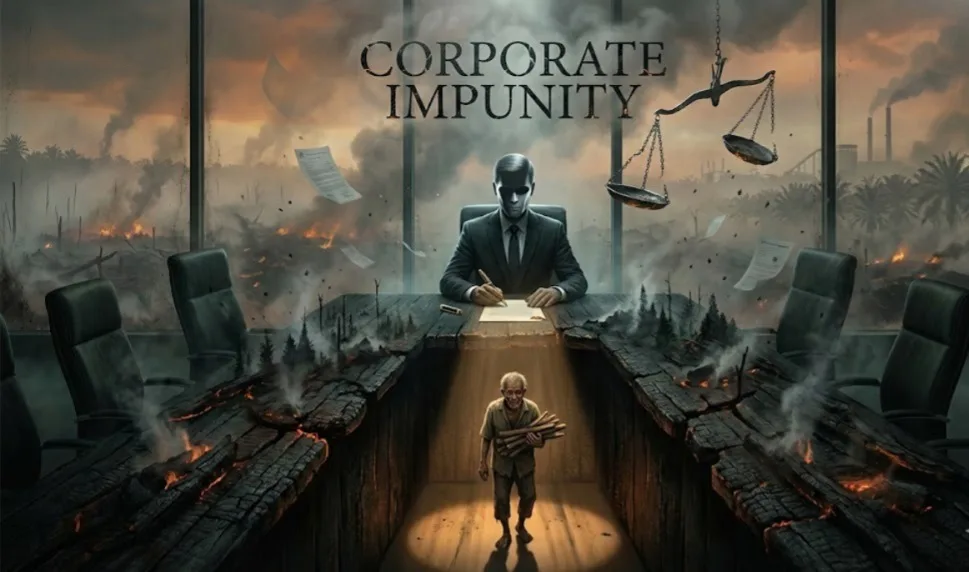
Legal Literacy - There is a smell of smoke that not only sticks in the throat, but also clings to our ideas about law: strict on the weak, weak on the strong. When a grandmother stealing wood is processed quickly, but a large corporation that burns down a forest gets away with just a fine, we are witnessing a systemic institutional failure, not a law enforcement accident. This phenomenon is not merely a matter of inefficiency: it demands that we re-examine the doctrines, evidentiary mechanisms, and power relations that enable corporate impunity against massive ecological damage. We live in the shadow of the irony of the Rechtsstaat, where criminal law loses its teeth when faced with artificial legal subjects.
The Paradox of Environmental Law Enforcement in the Rule of Law
This cracked mirror of law enforcement is clearly visible in the massive forest and land fires (Karhutla) in 2015 and 2019. Although thousands of hectares of concession land were burned and caused trillions of rupiah in losses and mass URTI, very few corporate executives felt the cold of the prison floor (Walhi, 2020). The answer is tucked between the folds of obsolete legal doctrines. Although the Supreme Court has issued Supreme Court Regulation (PERMA) Number 13 of 2016 concerning Procedures for Handling Criminal Cases by Corporations, practice in the field shows acute hesitation. Prosecutors and judges are still held hostage by the conventional paradigm of mens rea (evil intent) that is attached to biological humans, not business entities.


The Problem of Corporate Mens Rea in Environmental Crime
The biggest difficulty in bringing corporations to justice is translating the "malicious intent" of a business entity. Decisions to cause damage, such as ignoring fire prevention standards, are rarely written as "criminal orders" in the minutes of board meetings. The crime is hidden in the guise of cost efficiency and willful blindness. When disaster strikes, the tiered corporate structure allows decision-makers to hide behind the separate legal entity doctrine. As a result, our criminal law is only able to reach field operational managers, while the intellectual perpetrators who enjoy the benefits of environmental cost savings remain untouched in their ivory towers (Santoso, 2022: 45).
The Deviation of the Ultimum Remedium Principle in Environmental Law Enforcement
This problem is exacerbated by the misinterpretation of the ultimum remedium doctrine. The principle, which in reality places criminal law as a "last resort", has now become a shield of impunity. In the Environmental Protection and Management Law (UUPPLH) and reinforced by the spirit of deregulation in the Job Creation Law (2023), administrative sanctions seem to be the prima donna. The logic is "restoration", but the practice is "transaction". Corporations prefer to pay fines that are calculated as a cost of doing business rather than comply with environmental standards. When the law is reduced to a calculation of profit and loss, the deterrence effect becomes sterile.
Weaknesses in Proving Causality in Environmental Cases
Structural weaknesses continue in the rigid standards of proving causation. Public prosecutors are required to prove the causal relationship beyond a reasonable doubt between factory activity and ecological damage, which is often cumulative. This scientific gap is exploited by corporate lawyers to refute charges through "expert battles" in the courtroom (Wibisana, 2023: 112). To that end, concrete evidentiary reforms are needed: (a) the formation of an independent scientific team for sampling (chain of custody), (b) the application of legal presumptions regarding pollution source points based on forensic evidence, and (c) strict admissibility rules for expert testimony so that trials do not get lost in technical jargon.
State-Corporate Crime and the Political Roots of Environmental Impunity
Behind the legal technicalities, the thickest barrier is state-corporate crime. Concession permits on peatlands do not fall from the sky; they are signed by public officials. Suing corporations often means opening a Pandora's box that drags in state actors. This is the cause of "selective paralysis" or regulatory capture, where environmental cases often end with SP3 (Order to Terminate Investigation). This situation urges us to abandon anthropocentric glasses and recommend the adoption of the concept of Ecocide as an extraordinary crime. Ecocide must be interpreted as an unlawful or reckless act with knowledge of the risk of severe and widespread environmental damage.
Proposed Ecocide Clause in National Criminal Law Reform
As a concrete step, here is a proposed model Ecocide clause that needs to be considered for inclusion in the revision of national criminal law:
“Anyone who, either through actions or corporate policy, commits an act that is reasonably expected to cause severe, widespread, or long-term environmental damage, shall be sentenced to a minimum of 10 years imprisonment and a corporate fine of at least the equivalent of the ecological loss. For the crime of ecocide committed by a legal entity, the principle of strict liability applies; the burden of proof for the existence of preventive measures (due diligence) rests with the corporate defendant.”
Strict Liability and Reversal of the Burden of Proof in Serious Environmental Crimes
The application of this concept urgently requires a shift towards Strict Liability for severe environmental cases. The public prosecutor does not need to prove the subjective malicious intent of the directors; it is sufficient to prove that the damage occurred and that the corporation had control over the activity. The burden of proof must be reversed: it is the corporation that must prove in court that they have carried out maximum due diligence. Without this, the state will always be one step behind corporate resources.
Piercing the Corporate Veil and Criminal Liability of Directors
Furthermore, the law needs to pierce the corporate veil through a transparent Beneficial Owner Registry reporting mechanism. Individual criminal liability for directors must be imperative in cases of ecocide by adopting the Command Responsibility doctrine: superiors are criminally liable for failing to prevent damage (Atmasasmita, 2021: 89). The punishment must be a deadly combination for profit motives: imprisonment for decision-makers, massive fines for entities, and mandatory ecological restoration orders, the funds for which are secured through an escrow fund at the beginning of the investigation.
Environmental Law Enforcement Reform as a State Imperative
Faced with a systemic threat to the life-support system, rhetoric is not enough. We need three measurable changes: (1) reform of the doctrine of corporate responsibility towards strict liability in cases of ecocide, (2) a mechanism for reversing the burden of proof and credible environmental forensic evidence, and (3) legal penetration of beneficial owners and a mandatory ecological restoration mechanism. If the state fails to form an effective legal instrument, it chooses impunity as a public policy. That is not the will of a healthy law; it is an admission of collective failure. The law must return to functioning as a guardian of sustainability, not a tool for legitimizing destruction.















Comments (0)
Write a comment