
Legal Literacy - The criminal law reform through the enactment of Law Number 1 of 2023 or the Criminal Code (KUHP) and Law Number 20 of 2025 or the Criminal Procedure Code (KUHAP) as of January 2, 2026, is still understood simply as a technical change to the formulation of offenses and criminal sanctions. However, there is a fundamental shift that has escaped the attention of business actors. Now, corporations are placed as full criminal subjects, no longer just objects of administrative sanctions. New Criminal Code (KUHP) clearly stipulates principal and additional penalties for corporations. This shift not only changes who can be convicted, but also touches on the basis of business certainty in Indonesia. Responsibility for criminal acts by corporations, which was initially directed to both the corporation and its management, is now clarified that the responsibility primarily lies with the corporation. Only then can it be translated to the management or controlling party as regulated in Article 49 Paragraph 1 of the New Criminal Code.
So far, the business world has operated on the assumption that business disputes are fundamentally resolved through mechanisms of civil law such as contracts, compensation, default, and unlawful acts (PMH). Criminal law is positioned as an ultimum remedium that is used in a limited way for acts containing malicious intent (mens rea) such as fraud or embezzlement. However, the new Criminal Code now introduces a new paradigm that corporations can be subject to fines (principal penalties), additional penalties and various actions that have a direct impact on the structure and sustainability of the company, which are more sharply regulated in Articles 329 to 338 of the Criminal Procedure Code.
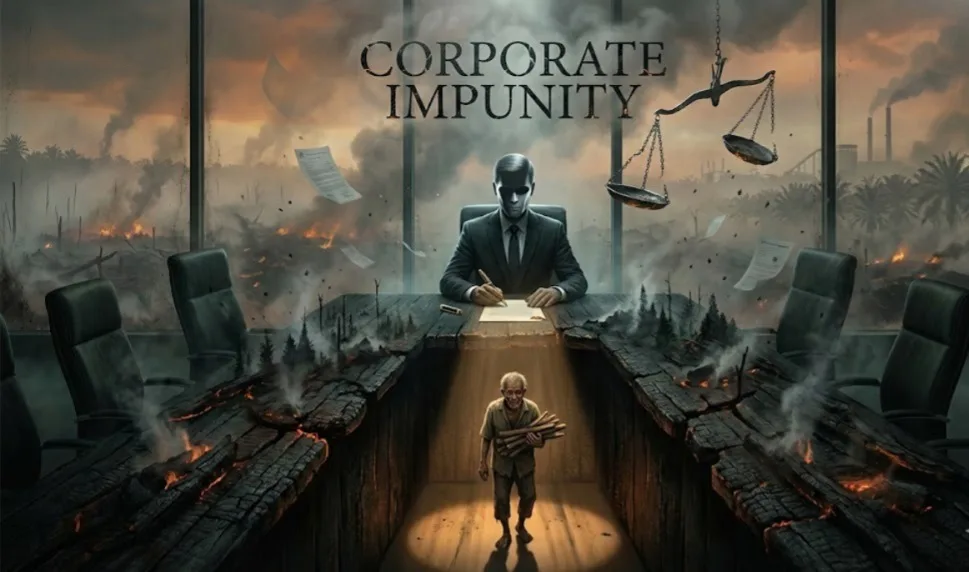


Corporations in the new Criminal Code regime are placed as full subjects with the consequence that criminal law can penetrate the heart of business activities such as financial balance sheets, operational structures, and corporate governance. All criminal sanctions normatively place criminal law no longer as an instrument outside the business world, but transformed into a regulatory factor that works through financial and operational mechanisms. For example, Article 122 paragraph (3) of the Criminal Code stipulates that when fines or additional penalties are not met, the corporation's assets or income can be confiscated and auctioned by the Prosecutor to pay off the criminal obligations. More specifically, in Article 122 paragraph (4) of the Criminal Code, if it is still insufficient, the corporation can be subject to a substitute penalty in the form of freezing part or all of its business activities.
These changes have important intersections with civil law. In the Civil Code (KUHPerdata), compensation arises from default or unlawful acts (PMH) that must be proven through civil court mechanisms. The new Criminal Code (KUHP) introduces the obligation to recover losses and confiscate profits, which functionally resembles restitution and compensation. Now, criminal judges can potentially determine the value of economic losses and order recovery as long as there is a criminal act as the basis of the legal event. However, it must be emphasized that the criminal mechanism is not intended to replace the settlement of purely civil disputes. Contract disputes that qualify as default with good faith remain within the civil realm. Only agreements used as instruments of crime can escalate to the criminal realm.
Implications for Investors and Creditors
The new configuration of corporate criminalization has direct implications for the position of investors and creditors. The new Criminal Code (KUHP) opens the possibility of executing fines for compensation and criminal restitution against corporations through the mechanism of confiscation and auction of corporate assets if they are not fulfilled within the period specified in Article 122 of the Criminal Code (KUHP). Furthermore, if the corporation's assets or income are insufficient to meet the criminal fine, the new Criminal Code (KUHP) allows for the imposition of a substitute punishment in the form of freezing part or all of the corporation's business activities. Factually, this condition not only affects the asset structure but also potentially reduces the corporation's ability to generate cash flow to fulfill its contractual obligations.
In this context, criminal claims on corporate assets can practically "compete" with creditors' civil claims. In other words, the certainty of fulfilling the rights of investors and creditors is now also influenced by corporate criminal exposure, not solely by financial performance and administrative compliance. This shift also marks a transformation in the role of criminal law, from initially functioning to punish, to now taking on a corrective role towards the economic consequences of violations. The state not only punishes the perpetrators but also corrects the economic impact through loss recovery, profit confiscation, and restrictions on business activities. Ultimately, criminal law is now part of the regulatory framework for the economy of society and the state.
For the business world, this change requires a paradigm shift. Compliance is no longer sufficient to be understood as formal fulfillment of regulations but must also be positioned as a business sustainability strategy. The criminal risk prevention system needs to be integrated into corporate governance, risk management, and corporate culture. This aims to ensure that compliance also functions to maintain the legal existence of the company itself. On the other hand, this reform is a step forward in encouraging a more responsible business world. However, without clear implementation guidelines and awareness of change by the corporation, this will also become a potential uncertainty and a trap for legal corporations that are not competent, especially for small and medium enterprises that may still have limited resources.
Therefore, a joint effort between policymakers, law enforcement officials, and the business community is needed to ensure that the expansion of corporate criminal liability functions as an instrument of development and stabilization, not a source of uncertainty. Transparent implementation guidelines, clear standards for assessing losses, and protection for legitimate business continuity need to be part of the new Criminal Code implementation agenda. The entry of criminal law into the business world is not just a technical change, but a major paradigm shift in the Indonesian legal system. Business certainty is now no longer only determined by contracts and administrative regulations, but also by the corporation's ability to build legal sustainability through substantive compliance.













Comment (0)
Write a comment