
Our Problems with the Criminal Procedure Law
Read Also
See more


Absence of Understanding of Criminal Acts and Criminal Liability
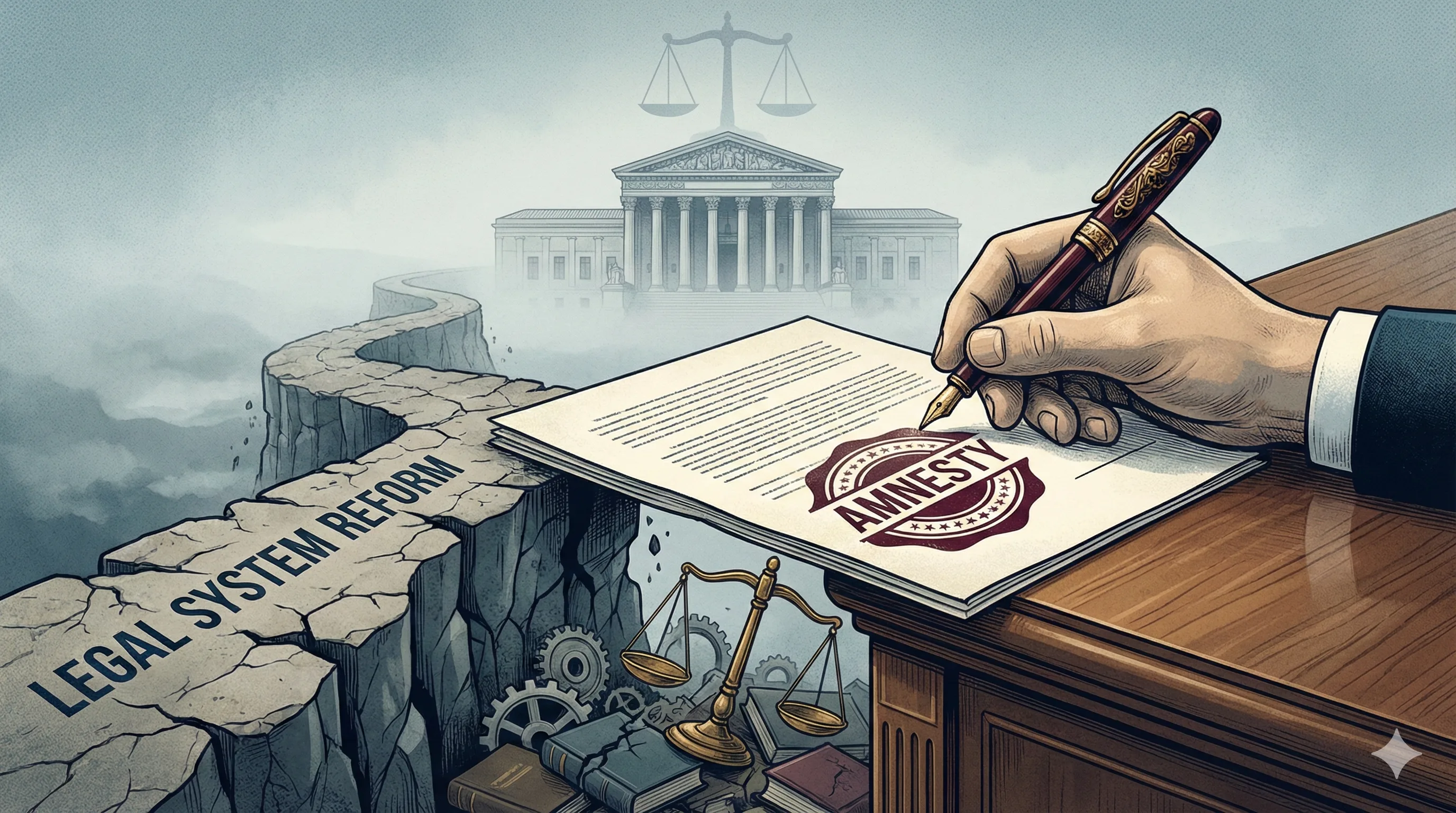
The problems that exist in the current Criminal Procedure Code, for example, are the absence of regulations regarding the understanding of criminal acts and criminal liability in the Criminal Procedure Code. Thus, the absence of regulations regarding the understanding of criminal criminal actacts and criminal liability creates problems in implementation with differences in interpretation of the implementation of criminal acts and criminal liability in criminal law enforcement in Indonesia.
Although it is known that Indonesia, which was formerly a Dutch colony, was influenced by the teachings ofcriminal lawof the Netherlands, which is monistic. Where in this monistic view, the issue of "responsibility" is basically seen as part of the "criminal act". Thus, in the monistic view, a "criminal act" inherently includes the ability to be responsible. Against this monistic view, dualistic thinking has also begun to develop in Indonesia.Criminal Justice System Implementation
In addition, in criminal law enforcement, the problem that always arises is related to the criminal justice system. The Criminal Procedure Code is intended as an instrument to protect society from arbitrary actions by law enforcement officials. The basic essence of its regulation is to limit state power, but in its implementation there are structural, cultural and substantial problems.
This is due to the various ambiguities in the formulation of the provisions in the Criminal Procedure Code, when compared with the principles that underlie and are behind the regulation of the issue. This creates problems in legal practice, especially the inability to implementequal treatmenttowards suspects and defendants of criminal acts, even though the concrete events are more or less the same but result in the neglect of the collective rights of all citizens not to be treated discriminatorily and the individual rights of everyone to be guaranteed equal and fair treatment.The ambiguity of the formulation of provisions in the Criminal Procedure Code (KUHAP) will lead to arbitrary actions by law enforcement officials in criminal law enforcement.
Whereas the existence of law and its institutions has the essence to promote justice by identifying moral values and moral systems that have settled in the social structure. In addition, by forming a system of legal norms in the Criminal Procedure Code, it is intended to create justice itself.
The concept of justice arises from the assumption that a moral value does not conflict with the law. Justice is a part of morality that has crystallized, in the rules of positive legal order, and basic norms in social life.
The use of criminal law is considered as a means of achieving true justice, even though criminal law is a form of criminal path that is not used in abeyond reasonable doubtthen what happens is notreasonable justicebutreasonable injustice.
Justice can be achieved by forming a modern and responsive legal structure. Legal institutions must be flexible, therefore changes to the legal structure are easier compared to changing the substance of the law, especially criminal law.Criminal justice can be interpreted as a process that works within several law enforcement agencies. Criminal law enforcement is a series of activities as a manifestation of the operationalization of restoring individual, social and community welfare balance, from violations of criminal law rules.
Meanwhile, the criminal justice system or (criminal justice system) is a system of processing a criminal justice, each component function consisting of the Police as investigators, the Prosecutor's Office as public prosecutors, the Court as the party that adjudicates and the Correctional Institution which functions to reintegrate convicts into society, working together, integrated in an effort to achieve a common goal, namely combating crime.
The criminal justice system does not only manifest itself as a physical system (physical system), as manifested in the interface-like relationship between sub-systems, but it must also be realized that there is an abstract relationship, related to the necessity of having the same appreciation of the legal values that are the goals and operational basis of each sub-system in the criminal justice system.
In the criminal justice process, it starts from the actions of investigation, inquiry, prosecution to examination in court. The police have the authority to carry out investigation to inquiry, the prosecutor's office has the authority in terms of prosecution, the judge has the authority to examine and adjudicate in court. Despite the differences in authority possessed by the Police, the Prosecutor's Office and the Judge, it is basically a system within the criminal law enforcement system regulated in the Criminal Procedure Code.At the beginning of its formation, the Criminal Procedure Code was referred to as a "masterpiece", but along with the increasing development of the world of science and legal practice, the systemic weaknesses designed to require responses that are not only the responsibility of the legislator but also require anticipatory constitutional steps are increasingly visible.
This is a direct consequence of ignoring the constitutional mandate in the substance of the Criminal Procedure Code. Therefore, it is necessary to adjust several provisions of the Criminal Procedure Code that are considered lagging behind and not in accordance with the current needs of criminal procedure law.In the perspective of the Criminal Procedure Code, the operationalization of the criminal justice system is carried out with reference to the concept of functional differentiation and the concept of integration, meaning that although each sub-system has its own authority in accordance with its field of duty independently (functions of investigation, prosecution, court and criminal executor), the sub-systems must work coherently and integrally, as a unified system of criminal law administration.












Comments (0)
Write a comment