
Legal Literacy - This article will discuss the antinomy between legal certainty and legal justice. If a conflict arises between these two legal objectives, which should be prioritized? Justice or certainty?
The Dichotomy of Law between Legal Certainty and Justice Law
A German legal expert and legal philosopher, Gustav Radbruch, stated that the purpose of law is to fulfill justice, certainty, and expediency in social life. However, in the factual conditions of the law's implementation, these three legal objectives often reach a deadlock, like two different sides of a coin. On one hand, law with the aim of certainty can deviate from justice, but on the other hand, the justice that is realized does not fulfill certainty.


A factual example of the bifurcation of these two objectives is the case of Nenek Asyani, who was dragged to District Court Situbondo, East Java, on charges of stealing teak wood on Perhutani land in Jatibanteng Village. In fact, the teak wood was cut from Asyani's land, which had been sold in 2010.
In this case, this, the coin between legal certainty and legal justice. On the one hand, it is unjust for someone who only took teak wood planks, especially claiming it was on their own land, to be dragged to court and punished, even though she was later sentenced to probation. On the other hand, it must be so if we want legal certainty; no matter how small or how many reasons we make to get justice, legal certainty through the courts in accordance with the prevailing laws and regulations will definitely be prioritized.
So, which should be prioritized, Certainty or Justice?
Based on Dicky Eko Prasetio's article entitled "Judging Certainty and Guaranteeing Justice: A Study of the Antinomy of Certainty and Justice as Legal Objectives", it is stated that the hierarchical-pyramidal conception states that at a certain level of value, there are two values that have their own preferences, meaning that one value can eliminate the other if the eliminated value is hierarchically higher than the eliminated value. This hіеrаrkіѕ-ріrаmіdаl conception is often used in the context of the Pancasila philosophy where Pаnсаѕіlа as a system philosophy is a series of systems in which the first to the last precepts are a unity. So it is impossible for the precepts in Pаnсаѕіlа to stand alone because each precept in Pаnсаѕіlа also reflects other precepts.
Hierarchical-pyramidal in Pancasila is also in line with the goals of law. The goals of law according to Gustav Radbruch consist of three basic values: justice, expediency, and stability. The hierarchical-pyramidal of the three goals of law can be illustrated in the following illustration:
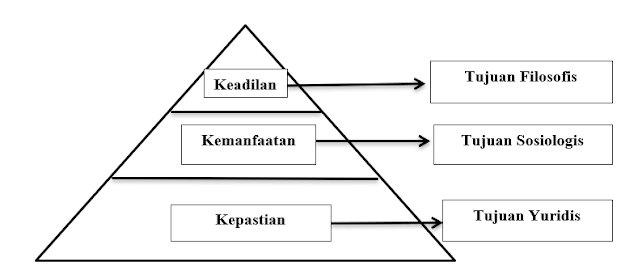 |
| Hierarchical-Pyramid Image, Source: Researchgate |
From the illustration above, it can be seen that a good law must pay attention to three aspects, namely the juridical aspect, the sociological aspect, and the philosophical aspect. In this hierarchical-pyramidal review, all legal objectives must move and run in unison, so that the law must not be rigid and frozen towards only one legal objective.
The existence of legal certainty and legal justice when facing an antinomy can be resolved with a principle “if there is a conflict between legal objectives, then the highest legal objective can override the lower objective”. This is in line with what Gustav Radbruch said that justice as the highest goal in law is then followed by expediency and certainty. However, Jimly Asshidiqie argues differently where if there is an antinomy between certainty, expediency, and justice, then it becomes a choice for the judge, whether the judge will affirm certainty, expediency, and justice, that is the independence for the judge.
However, for the Author, the conflict between legal certainty and legal justice is a necessity because justice itself has differences between one subject and another. If from the victim's point of view, justice is certainly that law enforcement is proportional according to the applicable rules. On the other hand, in the eyes of the perpetrator, justice is by not having to comply with the applicable law but prioritizing justice. This means that it does not have to be in accordance with the law as long as it is fair to him. A concrete example is in the case of grandmother Asyani, for herself and the community, justice is that not to stiffen the law in the sense of the Law, but to ensure justice by freeing grandmother Asyiani. On the Perhutani side, grandmother Asyiani must be punished for stealing as stipulated in the Law, thus creating legal certainty.
References
- Dicky Eko Prasetio, "Judging Certainty and Guaranteeing Justice: A Study of Antinomy of Certainty and Justice as Legal Objectives" www.researchgate.net
- Kunthi Tridewiyanti, “Pancasila as the Legal Ideal of Marriage for Indigenous Women and Believers”, National Law Seminar Vol.2 No. 1 2016
- A Salman Maggalutung, “The Relationship Between Facts, Norms, Morals, Legal Doctrines in Judges' Decisions”, Jurnal Cita Hukum Vol. 2 No. 2, December 2014













Comments (0)
Write a comment