
Legal Literacy - This article discusses the criminal justice system in Indonesia, highlighting inefficiencies and existing problems, including corruption and high costs. Focusing on two reform approaches, plea bargaining and special track as proposed in the Draft Criminal Procedure Code (RKUHAP), this article explores the differences between the two systems and how they could potentially speed up the judicial process while adapting to local legal dynamics. This discussion is important in the context of finding fairer and more efficient solutions for the criminal justice system in Indonesia.
The Hustle and Bustle of the Justice System
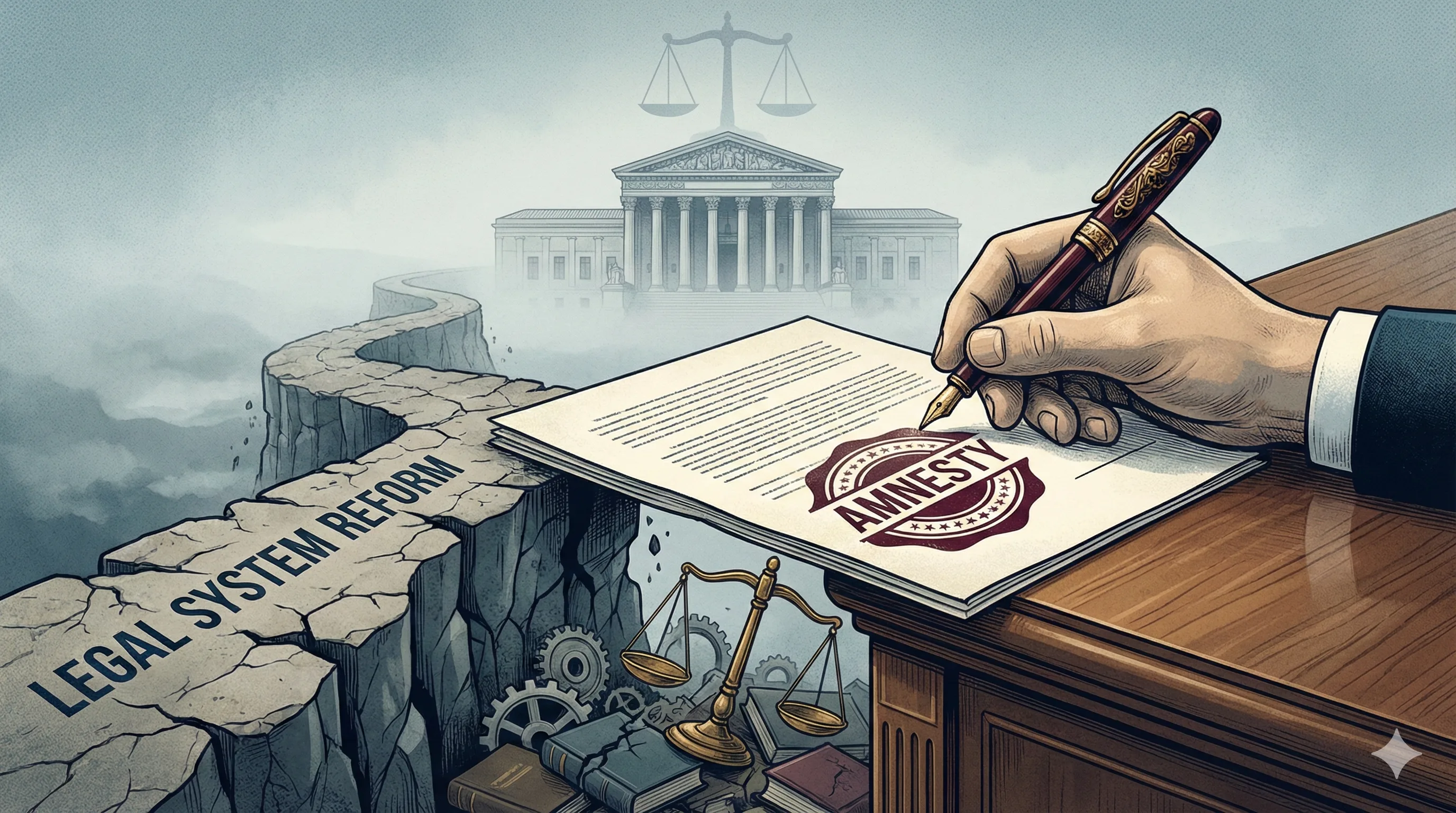
It can be said that there is no end to the problems related to the justice system in Indonesia. Especially in the criminal scope, it requires a longer process and time, for example, coercive measures, pre-trial, appeals, and cassation. Ironically, this is often underestimated, even though the justice system should realize the principle of simple, fast, and low-cost justice in examining cases in accordance with the mandate of Article 2 Paragraph (4) Law No. 48 of 2009 concerning Judicial Power.


Not only that, a Researcher from the National Legal Development Agency of the Ministry of Law and Human Rights of the Republic of Indonesia, Chairul Huda, stated that there are several problems in the criminal justice system in Indonesia, namely the accumulation of cases (overloaded), time-consuming (waste of time), expensive costs (expensive), corruption practices (judicial corruption), unable to accommodate the public's sense of justice (unresponsive), too rigid, formal, and technical (non-flexible, formalistic, and technically).
With various problematic points related to the judicial process, it is hoped that there will be a repressive handling effort for this matter, one of which is the implementation of plea bargaining, which is a legal effort made by reducing the charges while forgiving the defendant, when he wants to admit his guilt. Of course, this has received pros and cons responses from various groups. Some are of the view that this system is important to speed up the judicial process while accommodating legal dynamics in society.
In fact, this has been stated in the Draft Criminal Procedure Code (RKUHAP), but there are differences in the definition, substance, and procedure of plea bargaining implemented in other countries with the special track in the national RKUHAP. So, if we look at the two, which one is more appropriate to be implemented in Indonesia?
The Concept is Called “Special Track”.
Article 199 of the Draft Criminal Code (RKUHAP) contains provisions discussing a special track adopted from the plea bargaining concept. Unlike plea bargaining in Common Law countries, this special track does not employ negotiation or bargaining methods between the prosecutor and the defendant but depends solely on the defendant's voluntary confession during the trial. Therefore, the plea bargaining concept in the RKUHAP is often referred to as 'plea with no bargain.'
The special track in the RKUHAP essentially explains that the defendant can admit their guilt before the court when the public prosecutor reads the indictment. The defendant's voluntary admission of guilt will then be assessed and considered by the judge first. Only after the judge permits it can the public prosecutor transfer the case from the regular examination hearing to a summary examination, provided that the alleged sentence does not exceed 7 years of imprisonment.

Plea Bargaining and Plea With No Bargain
The special track, also known as 'plea with no bargain,' accommodated in the RKUHAP has significant differences from plea bargaining in other countries, such as the United States, where bargaining is conducted by the public prosecutor and the defendant before the case reaches trial. The Supreme Court of the United States has stated that the implementation of plea bargaining is a desirable element in the criminal justice system because it has proven to be able to handle the large number of incoming cases and reduce the time and costs in the case resolution process.
Therefore, the adoption of this system in the RKUHAP is believed to be able to realize an effective judicial process. Unfortunately, the procedure of the adopted system is so different. The special track of the RKUHAP is carried out during the trial, namely after the indictment is read. The special track focuses more on the defendant's confession in court, which is directly assessed by the judge. Thus, there is no negotiation process between the public prosecutor and the defendant like plea bargaining in general.
Incompletely Detailed Draft
The concept of a special track presented in the RKUHAP is still quite vague. For the sake of justice and legal certainty, we need a specific regulation that discusses this in depth so that law enforcement officials can understand their job descriptions and procedures, and defendants and victims can have clarity regarding their rights.
The substance of these special rules may include: (1). the time limit for implementing the special track in question, whether it is carried out only during the reading of the indictment or can be carried out at all stages of the trial before the verdict, considering that this concept focuses on the defendant's confession. (2). details of the requirements for a defendant to be able to take the special track, and vice versa. (3). conditions for the elimination and reduction of sentences by the judge. (4) the minimum and maximum sentence reduction that the defendant gets and other things that may need to be regulated.
The Impact of Implementing a Special Track
If implemented according to the plan, namely the special track is carried out when the indictment is read by the public prosecutor. As a result, its implementation can reduce the burden of cases in court, such as no appeals and cassation because the defendant's sentence has been reduced. Of course, handling the case no longer requires months of time and a lot of money.
Furthermore, it is undeniable that the defendant's right to be tried in detail by a judge will be minimized. This raises concerns that it will create resentment on the part of the victims who feel marginalized and feel unfair. Therefore, additional regulations are needed regarding the requirements for defendants who can take a special path so that justice can be fulfilled.
Another possible impact that may arise when this special track in the Criminal Procedure Code Bill is implemented is the possibility of behind-the-scenes dealings between the defendant and the judge in the trial who agree to take the special track so that the defendant receives a reduced sentence. This opens up a new field of corruption within the scope of justice. This new concept, in addition to being for judicial reform, also pollutes the dignity of the court.
In order to prevent various concerns regarding this special track from being realized, special regulations are needed regarding this matter, so that it is clear and detailed how exactly the special track process is intended by the rule formulators, and it needs to be considered and strengthened from the supervisory side. In the end, whatever system is chosen in the context of national Criminal Procedure Code reform, justice, legal certainty, and benefit must be the main benchmarks in the enactment process.








Comments (0)
Write a comment