
Legal Literacy - GBHN is the state policy with the administration of the state in broad outlines made as a statement of the people's will in a comprehensive and integrated manner. The GBHN is determined by the People's Consultative Assembly (MPR) for a period of five years. The discourse on reviving the Broad Outlines of State Policy (GBHN) reflects a collective anxiety about the direction of national development, which is considered not fully sustainable. Amidst the dynamics of electoral democracy and regular leadership changes, there is an assumption that Indonesia needs a long-term and binding state policy. However, behind this idea lies a latent tension between the need for development stability and a commitment to the principles of constitutional democracy.
This tension is important to analyze, considering Indonesia's historical experience shows that development stability is often built at the expense of political freedom and public participation. Therefore, the GBHN discourse cannot be separated from the fundamental question: to what extent can stability be guaranteed without eroding democracy?



GBHN as an Instrument of Development Stability
Conceptually, the GBHN is designed as a general guideline for national development that functions to maintain policy continuity across government periods. In this framework, the GBHN is seen as capable of overcoming policy fragmentation due to differences in political vision between Presidents. Development stability is understood as a prerequisite for economic growth, equitable welfare, and legal certainty.
This argument finds its relevance in development practices that are often short-term and electorally oriented. Without a clear state policy, development risks losing its strategic direction. This is where the GBHN is positioned as a normative instrument that is believed to be able to reorganize the orientation of national development in a more planned and sustainable manner.
Dimensions of Democracy and People's Sovereignty
On the other hand, democracy demands that the direction of development be determined through inclusive political mechanisms that are based on people's sovereignty. After the amendment of the 1945 Constitution, the President obtains direct legitimacy from the people through general elections. Consequently, the vision and mission of the President are a manifestation of the will of the people that cannot be simply restricted by the mandate of other institutions.
Past experience shows that the GBHN, when determined by the MPR as the highest state institution, makes the President a mandatory who is politically responsible to the MPR. This pattern has the potential to shift the locus of sovereignty from the people to the institution, thus contradicting the principles of modern democracy that place the people as the main source of legitimacy of power.
Latent Tension between Stability and Democracy
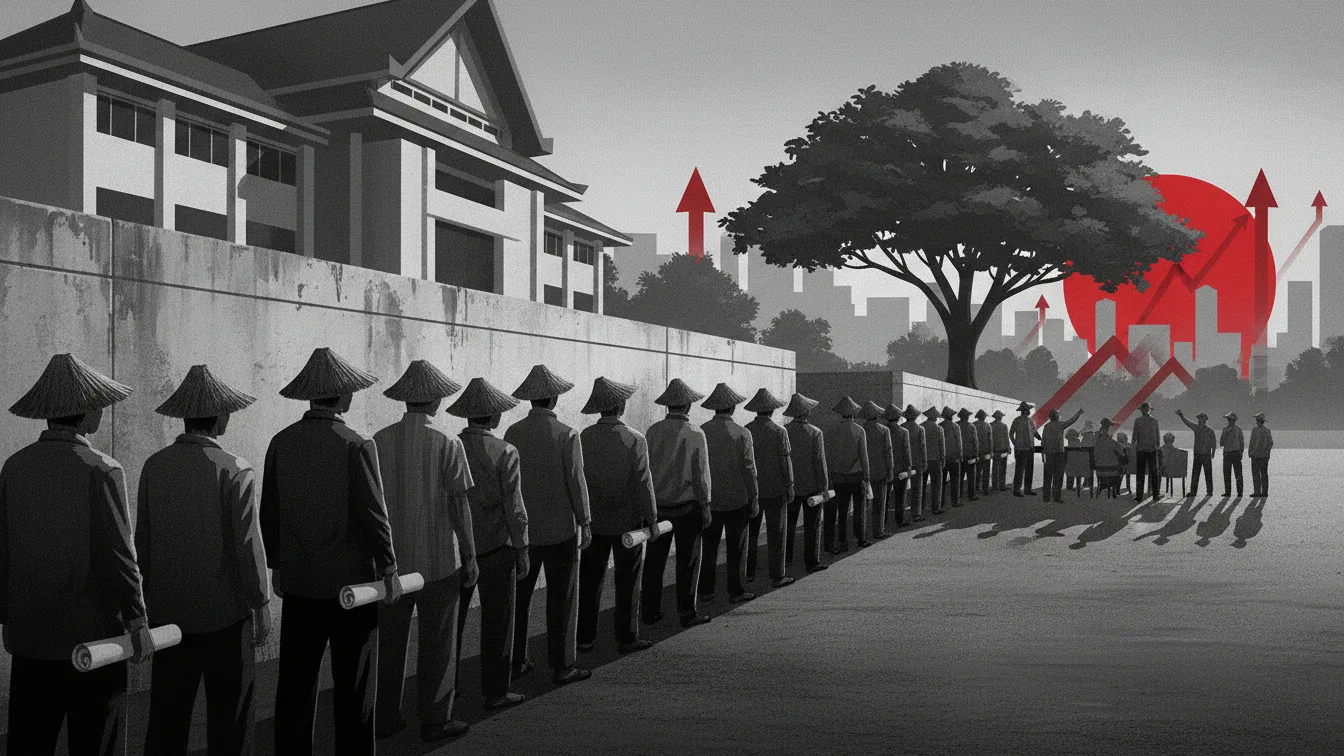
The latent tension between development stability and democracy lies in the binding nature of the Broad Guidelines of State Policy (GBHN) itself. On the one hand, the binding nature is necessary to guarantee the consistency of long-term policies. However, on the other hand, this nature potentially limits the President's political discretion and undermines the electoral mandate given by the people.
This tension is not always explicitly visible, but it can appear in the form of subordination of government policies to the state policy guidelines formulated in an elitist manner. In the long term, this condition risks giving rise to procedural democracy that lacks substance, where people's participation is reduced to mere electoral formalities.
Alternative State Policy Guidelines in a Democratic Framework
To reduce this latent tension, it is necessary to formulate state policy guidelines that do not repeat the patterns of the past GBHN. Long-term development guidelines can be formulated through laws that are participatory, adaptive, and still respect the presidential system. Thus, development stability is not achieved through the subordination of executive power, but through democratic political consensus.
This model allows for a balance between the need for long-term development direction and policy flexibility according to the people's mandate. In addition, development evaluation mechanisms can still be carried out through the supervisory function of parliament without shifting the principle of the President's accountability to the people.
Conclusion
The discourse on GBHN essentially reflects a classic dilemma in developing democratic countries, namely how to balance stability and democracy. The latent tension between the two cannot be resolved with a regressive institutional approach. On the contrary, constitutional innovations are needed that are able to guarantee the continuity of development without sacrificing the sovereignty of the people and the principles of constitutional democracy. Thus, the future of Indonesia's state policy guidelines must be built on the foundation of democracy, not outside or above it.















Comments (0)
Write a comment