In summary
Read Also
See more


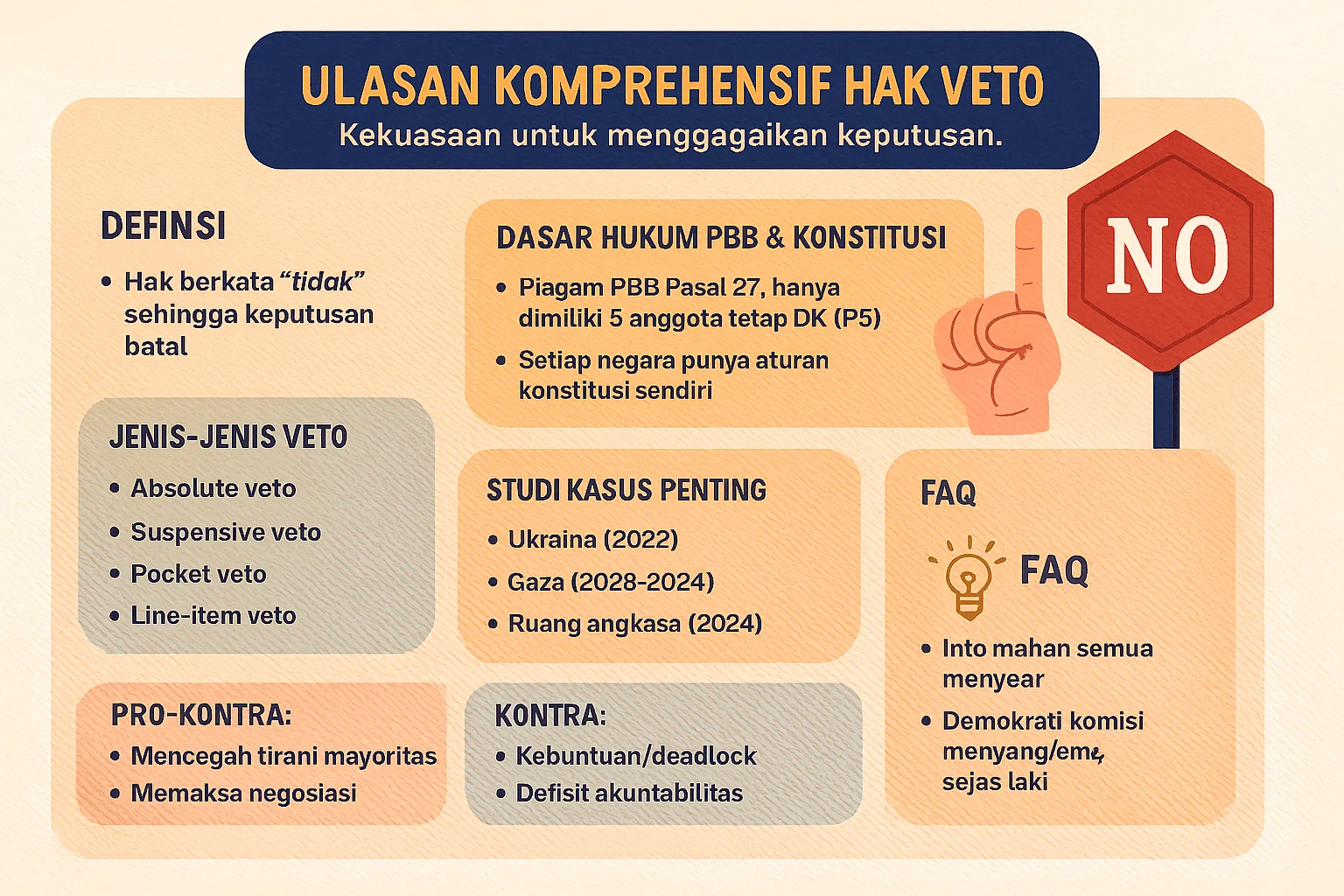
- Veto right is the authority to nullify or stop the enforcement of a decision, even if supported by the majority.
- In the UN, the veto is only held by the 5 permanent members of the Security Council (P5) and and only applies to substantivedecisions, not procedural. Abstain/absent not a veto. Source: United Nations – Voting System
- Since General Assembly Resolution 76/262 (2022), whenever there is a veto, the General Assembly is obliged to hold a debate on the related issue — increasing political accountability for the use of the veto. Source: UN Press (GA/12417)
- In the Indonesia, the President does not have the right to veto a bill that has been jointly approved by the House of Representatives; if not signed within 30 days, the bill remains valid became law. Source: BPHN – 1945 Constitution (PDF)
What is the veto right?
In simple terms, veto right is the right to say “no” to a decision so that the decision is nullified or cannot be taken. In practice, the veto functions as an emergency brake to protect the vital interests of the party holding it, forcing a process of negotiation/compromise, or preventing “tyranny of the majority”.The veto right in the UN
Legal basis & how it works
UN Charter Article 27 mentions decisions procedural taken with the support of 9 votes; decisions substantive require 9 votes including “concurring votes of the permanent members” (P5: China, France, Russia, United Kingdom, US). In practice, one negative vote of a P5 member = veto. Abstain/abstention is not considered a veto. Source: legal.un.org – Repertory Art. 27 Veto does not apply to procedural (e.g., changing the agenda, inviting speakers), thus these types of decisions cannot be blocked by the P5. Source: United Nations – Voting SystemLatest accountability: “Veto Initiative” (2022)
General Assembly Resolution 76/262 (26 April 2022) requires a debate in the General Assembly whenever a veto is cast in the Security Council. Source: UN Press (GA/12417) • UN Press (GA/12658)Ways to bypass the veto
“Uniting for Peace” Resolution 377A(V) (1950) allows the General Assembly to recommend collective measures when the Security Council is deadlocked due to a veto. Source: UN Digital Library (PDF) • Audiovisual Library – Uniting for PeaceData & trends in veto usage
Peace & Security Data Hub (UN) to publish datasets vetoes since 1946 (including annual visualizations). Source: psdata.un.org – Vetoes Since 1946 • Humanitarian Data ExchangeThe veto right in national constitutions
Practices vary by country. Here are some common models:United States (federal)
- US Constitution (Article I, Section 7) gives the President the right to veto bills. Congress can override a veto with two-thirds votes in the House and Senate. Source: Congress.gov – Constitution Annotated
- Line-item veto at the federal level overturned by the Supreme Court in Clinton v. City of New York (1998). Source: Oyez • Justia
Indonesia
There is no presidential veto right post-approval with the House of Representatives. Article 20 paragraph (5) of the 1945 Constitution: if a Bill that has been jointly approved is not passed by the President within 30 days, the bill remains valid it becomes law and must be enacted. Source: BPHN – 1945 Constitution (PDF)Philippines
The President possesses item/line-item veto specifically for bills regarding the budget,, revenue,or tariffs (1987 Constitution, Article VI, Section 27(2)). Source: The LawPhil Project – 1987 Constitution (Full Text)Brazil
Brazilian Constitution (Article 66) recognizes partial vetoes on specific parts (e.g., articles/sections/items). If the President remains silent for 15 days, it is considered sanctioned (approved). Source: normas.leg.br – Art. 66 • Planalto – Constituição Note: Many other countries implement suspensive vetoes (can be overridden by parliament), pocket vetoes (a silent veto during legislative recess), up to item/partial vetoes (striking out specific sections in a budget bill).Types of Vetoes
- Absolute veto: the decision is permanently annulled unless re-proposed with new conditions (rare in the modern era).
- Suspensive/qualified veto: can be overridden by a specific majority (e.g., 2/3). Example: US – Congress.gov
- Pocket veto: Bill is not signed until the deadline expires while the legislature is in recess, thus it fails (variations depend on state rules). Source: Congress.gov
- Line-item/partial veto: the executive strikes out specific items (generally budgetary) without rejecting the entire bill. Source: Philippines; Brazil; US (does not apply at the federal level)
Advantages & Disadvantages of Veto Power
Advantages
- Prevents tyranny of the majority and protects vital interests certain parties.
- Coercing negotiations so that policies tend to be more moderate.
- At the UN, the veto is seen by some parties as a guardian of stability between major powers, preventing direct confrontation.
Disadvantages
- Deadlock/deadlock on urgent issues (humanitarian/security).
- Democratic accountability deficit: one country/actor can override the choice of the majority.
- Geopolitical incentives: the veto is sometimes used to protect allies or narrow interests, rather than collective interests.
Important Case Examples & Current Context
- Ukraine (2022) – UN Security Council failed to adopt a resolution condemning Russian aggression because Russian veto; 11 countries in favor, 1 against, 3 abstentions. This prompted a meeting of the Emergency Special Session in the General Assembly. Source: UN Press (SC/14808) • UN Press (SC/14809) • Security Council Report – S/2022/155
- Gaza (2023–2025) – Several ceasefire resolution drafts vetoed in the SC. Reference: PBS NewsHour (2025) • Al Jazeera (Feb 2024) • U.S. State Dept. (June 2025)
- Outer space (2024) – Russian veto of a resolution on the prevention of nuclear weapons in outer space. Source: AP News • USUN Joint Statement
FAQ
What is the difference between substantive and procedural vetoes in the UN Security Council?
Veto only applies to decisions substantive (sanctions, peacekeeping operations, membership, etc.). Decisions procedural (agenda, speaker invitations) cannot be vetoed. Source: United Nations – Voting SystemIs it true that the term “veto” is not explicitly mentioned in the UN Charter?
True. The term is not mentioned, but Article 27 governs the mechanism of “concurring votes” of permanent members for substantive decisions — that is what is understood as veto right. Source: legal.un.org – Repertory Art. 27How does the General Assembly follow up when there is a veto?
Since Resolution 76/262 (2022), the General Assembly organizes a debate whenever there is a veto. Beyond that, Resolution 377A(V) “Uniting for Peace” provides a collective recommendation pathway when the SC is deadlocked. Source: UN Press (GA/12417) • UN Digital LibraryCan the President of Indonesia veto a Bill?
Not in the sense of a constitutional veto. A bill that has jointly approved by the House of Representatives will remains valid become law even if the President does not sign it within 30 days. Source: BPHN – 1945 Constitution (PDF)Why is the US President's “line-item veto” not valid?
Because The US Supreme Court (1998) ruled the Line Item Veto Act unconstitutional (violating the Presentment Clause). Source: Oyez – Clinton v. City of New YorkKey References (Selection)
- UN Charter Article 27 & voting practices: legal.un.org • UN – Voting System
- Supreme Court Resolution 76/262 (2022) & implementation: UN Press (GA/12417) • UN Press (GA/12658)
- Uniting for Peace 377A(V): UN Digital Library (PDF) • UN Audiovisual Library
- Veto dataset since 1946: psdata.un.org • HDX
- 1945 Constitution Article 20(5): BPHN (PDF)
- US Constitution Article I Section 7: Congress.gov
- Clinton v. City of New York (1998): Oyez • Justia
- Item/Partial veto in the Philippines & Brazil: LawPhil – 1987 Constitution • normas.leg.br – Art. 66








Comments (0)
Write a comment