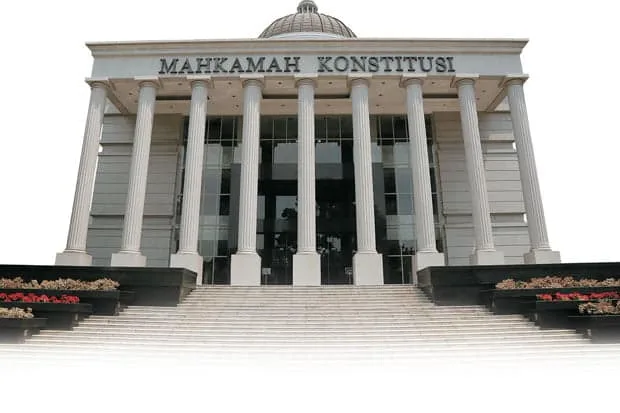
The Idea of General Election Dispute Process
As a judicial institution, in several cases the Constitutional Court often uses jurisprudence as a consideration in a decision. This occurs, for example, in Constitutional Court Decision Number 01-021-022/PUU-I/2003, 002/PUU-I/2003, and 058-059-060-063/PUU-II/2004. In the decision a quo, the Constitutional Court issued the same stipulation in all decisions so that it can be called faste jurisprudence or a permanent decision.[4]
The use of jurisprudence as a consideration in a decision can be in the form of applying a previous decision exactly to the case being handled or applying the legal reasoning that is the basis of the decision. The application of the same legal reasoning can answer legal problems that have the same characteristics. A judge can use the legal reasoning of a previous decision if the Judge considers that the legal reasoning can answer the case being faced.


Considering this, the Constitutional Court may use a similar step in the 2024 PHPU case. The similar step referred to is the use of teleological interpretation in resolving the PHPU case. The complexity of the PHPU Case demands a clear division and limitation of powers so that there is no centralization of power that regulates matters relating to Elections in one institution. Law Number 7 of 2017, with the latest amendment by Perpu Number 1 of 2022 which was stipulated as Law by Law Number 7 of 2023, has detailed regulations accompanied by the division and limitation of these powers. The juridical implication is that the complexity of the PHPU case can be mapped clearly and comprehensively.
In the nuances of the complexity of this PHPU case, one of the institutions that is in the spotlight besides the Constitutional Court is Bawaslu. This institution, which has the authority to supervise the election process, has a central position because this institution is given the authority to prevent and follow up on TSM violations in elections. Thus, when a TSM violation occurs in an election, only Bawaslu has the authority. This is as regulated in Law Number 7 of 2017 Articles 93-96.
The juridical implication is that the Constitutional Court does not have the authority to enter this realm so that the authority of state institutions is not mixed up. The sad thing is that the TSM fraud cannot be prosecuted before the Constitutional Court, leaving the impression that the fraud has not been completely resolved. This is because Bawaslu is already in charge of supervising and following up on fraud in and during the election process. Furthermore, Constitutional Justice Ridwan Mansyur stated that the Constitutional Court only has the position to ensure that Bawaslu has carried out its duties and does not have the right to go any further.
This can actually be resolved by first interpreting the Constitution and laws governing such authority. As explained above regarding Decision Number 138/PUU-VII/2009, the Constitutional Court first provided a teleological interpretation of the Constitution before deciding the a quo case. In the a quo case, the Constitutional Court conducted a judicial review of the Government Regulation in Lieu of Law (Perpu), while the Constitution does not attribute such authority to the Constitutional Court. To overcome this, in the a quo decision, a teleological interpretation was used by the Constitutional Court, resulting in an extension of the Constitutional Court's authority.
The teleological interpretation in resolving the 2024 General Election Results Dispute (PHPU) case involves viewing the constitutional articles that grant authority to the Constitutional Court from a teleological perspective. The Constitutional Court can depart from using grammatical interpretation by uncovering the purpose of the constitutional article in granting the authority to handle the PHPU. Grammatically, Article 24C paragraph (1) “The Court is authorized to…decide disputes regarding the results of general elections” only grants authority to the Constitutional Court regarding the resolution of results, not the process. However, teleologically, the a quo Article can be seen as an order to the Constitutional Court to resolve any election disputes, whether in the form of results or processes. This is logical because without the process being resolved first, good results will not be produced.
Looking at the explanation above, it is reasonable and possible for the a quo decision to be followed by the Constitutional Court in resolving this 2024 PHPU. By following the legal reasoning used in the a quo decision, the Constitutional Court can first extend its authority so that the Constitutional Court is authorized to address election cases tainted by structured, systematic, and massive (TSM) violations. If this happens, it will certainly greatly color the legal and constitutional landscape in this beloved country.
Regardless of all that, the decision issued by the Constitutional Court must be respected and implemented by all parties. Furthermore, there are no more legal remedies that can challenge the Constitutional Court's decision because the Constitutional Court's decision is a decision at the first and last level, or final. This indicates that the Constitutional Court's decision is final and binding. Like it or not, the Constitutional Court's decision must be respected and implemented without any legal process that can disturb it.
References
- Martitah. (2023). Constitutional Court from Negative Legislature to Positive Legislature. Jakarta: Konstitusi Press.
- NNC. (2007, November 27). Three Times the Same, Constitutional Court Decisions Become Permanent Jurisprudence? Retrieved from hukumonline.com: https://www.hukumonline.com/
- Palguna, I. D. (2020). Constitutional Court & Dynamics of Legal Politics in Indonesia. Depok: Rajawali Press.
- Talmadge, P. A. (1999). Understanding the Limits of Power: Judicial Restraint in General Jurisdiction Court Systems. Seattle University Law Review, 711.
[1] Wicaksana Dramanda, “Conceiving the Application of Judicial Restraint in the Constitutional Court”, Jurnal Konstitusi Vol. 11 No. 4, 2014, p. 620
[2] Phillip A. Talmadge, “Understanding the Limits of Power: Judicial Restraint in General Jurisdiction Court Systems”, Seattle University Law Review No. 695, 1999, p. 711.
[3] I D.G Palguna, Constitutional Court and the Dynamics of Legal Politics in Indonesia (Depok: Rajawali Pers, 2020); 1st printing, p. 104
[4] NNC (2007) “Three Times the Same, the Constitutional Court's Decision Becomes Fixed Jurisprudence?”; accessed on April 22, 2024 from https://www.hukumonline.com/






















Write a comment