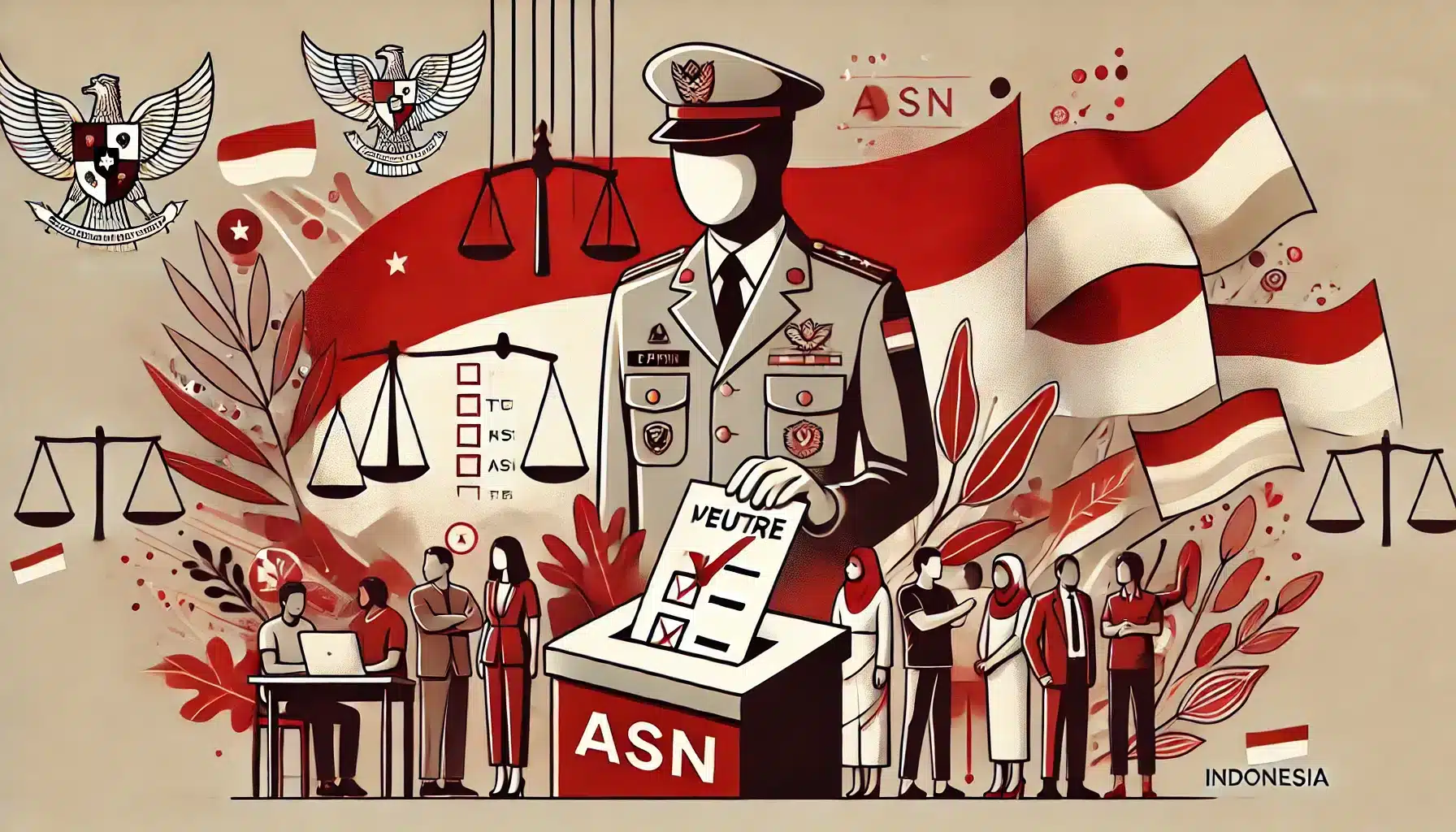
The Clash of ASN Neutrality with Human Rights
Among the indicators that can be used as a benchmark for ASN non-involvement or neutrality are not being involved in practical politics and not using their positions and authorities to facilitate election or regional election participants with state facilities.[2] ASN as a state instrument is obliged to prioritize the principle of neutrality as regulated in Article 24 paragraph (1) letter d. The application of this principle is explicitly contrary to freedom of speech (freedom of speech) as one of the human rights (HAM) because it limits the space for ASN to express themselves.
Jan Materson from the UN Human Rights Commission defines human rights as rights inherent in humans that are necessary to ensure a full human life.[3] One of the rights contained in human rights is freedom of speech (freedom of speech). This freedom was born from Socio-Political Rights (Sipol) as normalized in International Covenant on Civil and Political Rights (ICCPR). Sipol rights require negative actions from the state because the fulfillment of this right comes from the absence of state intervention.[4]


The Indonesian Constitution in Article 28E paragraph (3) also affirms that everyone has the right to freedom of association, assembly, and expression. The phrase “everyone” signifies that this constitutional norm includes every individual, even ASN who are state administrators. It should be noted that Article 28J paragraph (2) of the 1945 Constitution recognizes the concept of limitation, namely the state's authority to limit human rights under certain conditions and requirements.[5] Such restrictions on human rights can only be carried out by national law.
According to Soewoto, freedom of assembly and expression is indeed universal, but its implementation in the form of laws and regulations is not universal.[6] It is very possible that there are differences, such as restrictions on these basic rights. Restrictions on basic rights (human rights) are carried out using legal instruments as a form of application of the principle of narrow legality, namely wetmatigheid van bestuur.[7]
Based on the principle of legality, the restrictions imposed by law, in this case human rights, can be justified. This is also reinforced by the willingness of civil servants to sign “Contract Suigeneris”. With the signing of “Contract Suigeneris”, civil servants who hold public service relations cannot fully exercise their human rights. This is an implication of the application of the “special contract” theory which demands monoloyalty.[8]























Write a comment