17 Years of Kamisan Action: A Humanitarian Action That Continues to Await Justice
This article discusses the journey of Kamisan Action as a symbol of the struggle for democracy and the enforcement of human rights in Indonesia.
Opinion Note
This opinion article was written by a contributor/columnist. The views expressed are entirely the responsibility of the author and do not necessarily represent the views of the editors.
CONTRIBUTOR PROGRAM
You can become a columnist at Legal Literacy.
Submit your legal opinion/analysis writing. If it is published, you have the opportunity to obtain a payout/honorarium in accordance with the provisions.
Table of Contents
Legal Literacy - This article discusses the journey of Aksi Kamisan as a symbol of the struggle for democracy and the enforcement of human rights in Indonesia. Aksi Kamisan, which has been going on for 17 years, has become a collective movement to preserve the memory of gross human rights violations in the past. Under the leadership of President Jokowi, human rights enforcement still faces many challenges, including various unresolved violation cases. This article also highlights Jokowi's campaign promise to resolve unresolved human rights violation cases, as well as the negative impact on democracy and human rights indices in Indonesia.
After being in power for 32 years, the authoritarian New Order regime was successfully overthrown by the strength of the civil society movement. The collapse of the regime's power also marked the birth of a "new democracy" which has provided a number of flexibilities in carrying out social, national and state life practices. However, the process of democratization struggle in Indonesia has to be paid dearly.
Historically, the rise of the New Order authoritarian regime under Soeharto to power was marked by a flood of blood after the 1965 Gestapu. Likewise, with the collapse of tyranny which has caused various kinds of damage in various lines and serious human rights violations which have not been resolved until now.
There were many deaths from students/civil society, cases of rape and discrimination against minorities, to the disappearance of 13 activists. These dark events are a series of expensive struggles in upholding democracy and human rights in Indonesia.
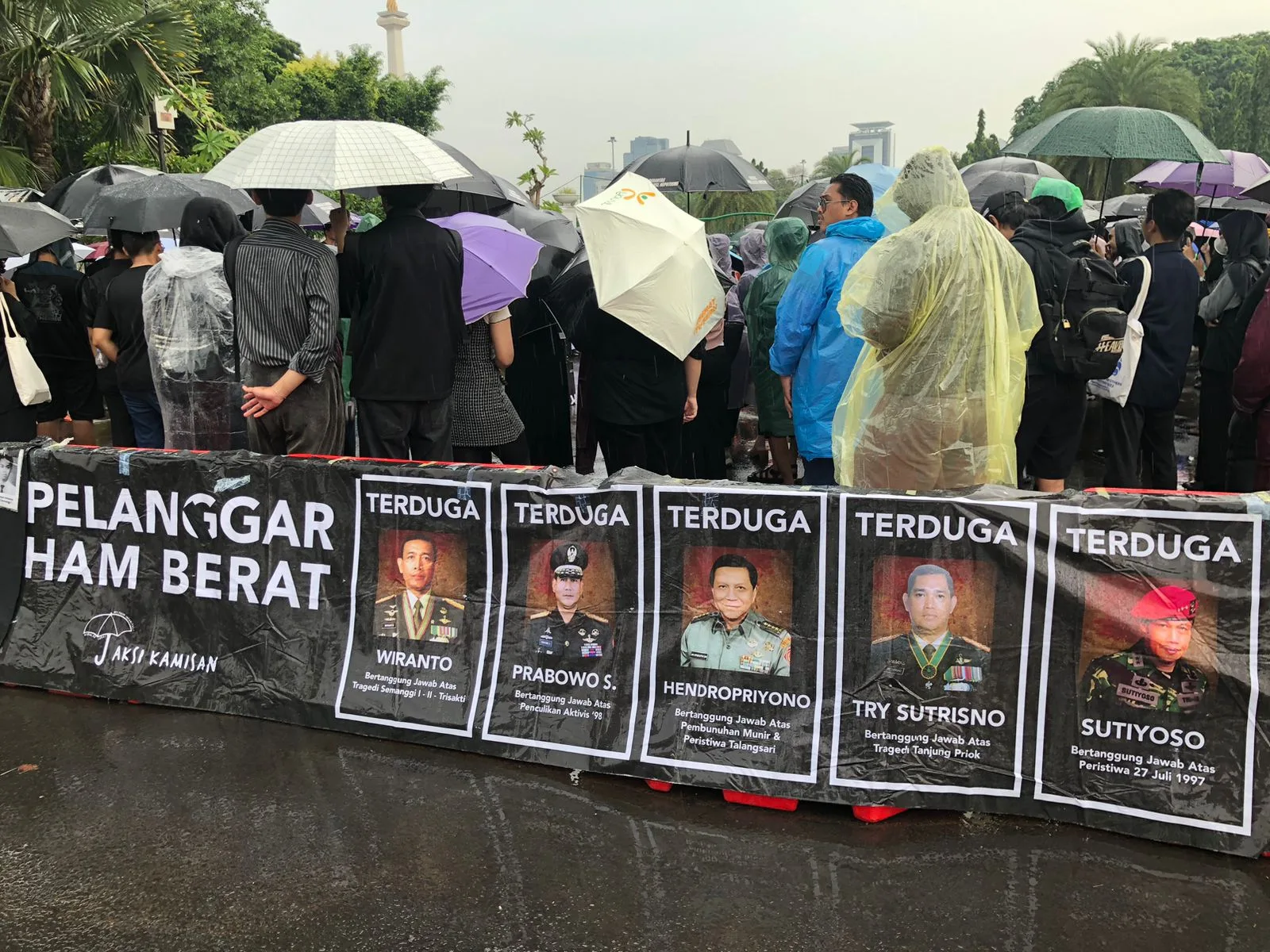
In addition, the events that have become a black note in the history of the Republic have caused deep wounds for the victims' families. The victims' families continue to collect, ask, and demand justice from the State. One of the ways that the families of victims of past gross human rights violations do is to show solidarity in front of the State Palace by using umbrellas, clothes and black attributes. This solidarity action is known as Aksi Kamisan.
Initially, Aksi Kamisan was an action initiated by three families of victims of gross human rights violations, namely Maria Katarina Sumarsih, mother of Bernardus Realino Norma Irmawan, one of the students who died in the Semanggi I Incident in November 1998; Suciwati, wife of the late Munir, an activist as well as a symbol of the struggle for human rights who was poisoned on a Garuda plane while on his way to the Netherlands; and Bedjo Untung, a representative of the families of victims who were suspected of being PKI sympathizers.
Now, Aksi Kamisan has been running for 17 years by carrying out actions more than 800 times. For 17 years, they (read: the victims' families) have been sitting in front of the palace every Thursday without getting a definite answer from the State and always going home empty-handed.
Support
• Indonesian Legal Literacy
Read more comfortably, while supporting literacy.
Join Membership or submit your article for publication.
Membership
Read without ads, focus more, and access premium features.
Submit Article
Submit your writing—we curate and help publish it. If it is published, you have the opportunity to earn points/payouts according to the terms.
Related Articles
See more




Popular Articles





Latest News
View all news


Public Space
See All




Pasang Iklan
Write a comment