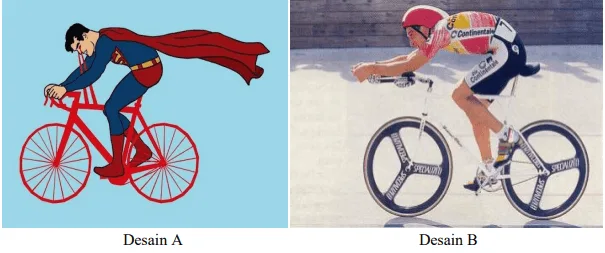
A. CASE POSITION
1. Antony is a Lecturer at PTNBH (State University with Legal Entity) who created Design B
2. Design A is a design that was exhibited in a national bicycle design exhibition in February 2021
3. Design A was then mass-produced and widely traded.


4. In addition to creating Design B, Antony also modified the design of traditional old bicycles (Ontel Bicycles) to be more fashionable
B. LEGAL ISSUES
- What is the most appropriate protection effort for Design B, is it Industrial Design or Patent, or both?
- Does Design B meet the novelty requirement with Design A as a comparison?.
- Which is the right approach to determine the novelty if viewed from the principle of minor or major/significant difference?
- Who is most entitled to own the patent rights?
- What is the appropriate form of protection for the Ontel bicycle design?
- Is the traditional bicycle design that has not been modified a design in the public domain (public domain) or owned by the state?
C. SOURCE OF LAW
1. Civil Code
2. Law Number 13 of 2016 concerning Patents
3. Law Number 31 of 2000 concerning Industrial Design
D. JURIDICAL ANALYSIS
1. Based on Article 1 Number (1) of the Industrial Design Law, it has been explained that Industrial Design is a creation concerning the shape of a configuration, or composition of lines or colors, or lines and colors, or a combination thereof which is three-dimensional or two-dimensional which gives an aesthetic impression and can be realized in a three-dimensional or two-dimensional pattern and can be used to produce a product, industrial commodity, or handicraft. Meanwhile, based on Article 1 Number (1) of the Patent Law, it is explained that a Patent is an exclusive right granted by the state to an inventor for the results of his invention in the field of technology for a certain period of time to carry out the invention himself or give approval to another party to carry it out.
Based on the general provisions above, it is clear that the most appropriate protection for Design B is Industrial Design Rights. This is because there is a differentiating factor between Patents and Industrial Designs where the difference is whether Design B is only a visual image as the characteristics mentioned in Article 1 Number (1) of the Industrial Design Law. Meanwhile, a Patent is an exclusive right granted with the characteristics of technical functional novelty.
2. Based on Article 1 number (5) of the Industrial Design Law, it is explained that Industrial Design Rights are exclusive rights granted by the state of the Republic of Indonesia to Designers for their creations for a certain period of time to carry out themselves, or give their consent to other parties to carry out these things. In addition, Article 2 of the Industrial Design Law explains that Industrial Design Rights are granted for new Industrial Designs where the novelty standard is on the Date of Receipt, the Industrial Design is not the same as previous disclosures, namely the disclosure of Industrial Designs made before the date of receipt or priority date if the Application is submitted with Priority Rights and has been announced or used in Indonesia or outside Indonesia.
3. Because the Industrial Design Law does not provide an answer on how to interpret the novelty requirement, the interpretation is left to judicial practice. This can be traced through Case No. 06/Industrial Design/2006/PN. Niaga. Jkt. Pst dated April 26, 2006; and Case No. 02/Industrial Design/2004/PN.Niaga.Jkt.Pst.
Even a slight difference in shape and configuration basically shows novelty. The approach of even a slight difference in shape and configuration has shown novelty. This approach has a legal basis in Article 1 number 5 of the Industrial Design Law. Based on this article, what is meant by industrial design rights is the exclusive right granted by the state of the Republic of Indonesia to the Designer for his creation for a certain period of time to carry out himself, or give his consent to other parties to carry out these rights.
4. Based on Article 6 of the Industrial Design Law that the party entitled to obtain Industrial Design Rights is the Designer or receives these rights from the Designer where if the Designer consists of several people together, Industrial Design Rights are given to them together, unless otherwise agreed. As we all know that the principle of freedom of contract has been guaranteed by the applicable law in Indonesia where this is regulated in Article 1320 of the Civil Code which states that an Agreement is considered valid if there is an agreement between the parties, legal capacity, a certain cause and based on a lawful cause.
If there is no agreement governing the rights and obligations that bind Antony and PTNBH, then of course the industrial design rights fall to Antony as the person who designed the sketch above.
In addition, based on Article 7 of the Industrial Design Law, it is explained that if an Industrial Design is made in an official relationship with another party within the scope of his work, the holder of the Industrial Design Rights is the party for and/or in whose service the Industrial Design is carried out, unless there is another agreement between the two parties without prejudice to the Designer's rights if the use of the Industrial Design is extended outside the official relationship. This also applies to Industrial Designs made by other people based on orders made in official relationships. If an Industrial Design is made in a working relationship or based on an order, the person who makes the Industrial Design is considered the Designer and the Holder of Industrial Design Rights, unless otherwise agreed between the two parties.
5. In addition to creating Design B, Antony also made modifications to the traditional old bicycle design (Ontel Bicycle) to be more fashionable. Then here we will determine what is the right protection for the modification of the onthel bicycle where Anotny wants to register exclusive rights for him. If we want to include it in the form of industrial design protection, we need to look at the provisions of Article 1 Number (1) of the Industrial Design Law which explains the definition of Industrial Design where Industrial Design is a creation about the shape of the configuration, or composition of lines or colors, or lines and colors, or a combination thereof in the form of three dimensions or two dimensions that gives an aesthetic impression and can be realized in three-dimensional or two-dimensional patterns and can be used to produce a product, industrial commodity, or handicraft.
Meanwhile, on the other hand, if we want to include it in the form of Patent Rights, we need to look at the provisions of Article 1 Number (1) of the Patent Law which explains the definition of Patent where a Patent is an exclusive right granted by the state to an inventor for the results of his invention in the field of technology for a certain period of time to carry out the invention himself or give approval to another party to carry it out.
We need to emphasize here, that what Antony is thinking and wants to do is to protect the modification of the onthel bicycle with the aim of making the onthel bicycle look more fashionable. Meanwhile, we know that the differentiating characteristic between Patents and Industrial Designs is that Patents are technical functional where this is based on the provisions of Article 4 of the Patent Law which explains that Inventions do not include aesthetic creations. Meanwhile, the Industrial Design itself is substantively visualistic.
Based on the explanation above, it is clear to us that Anthony must register the modification of his onthel bicycle with the Industrial Design Rights protection guarantee. The mechanism for applying for patent rights is explained in detail in Article 10 to Article 15 of the Industrial Design Law based on the first to file principle.
6. Based on Article 5 of the Industrial Design Law, Protection of Industrial Design rights is granted for a period of 10 (ten) years from the date of Receipt where the effective date of the protection period as referred to in the general list of Industrial Designs and announced in the Official Gazette of Industrial Designs. Based on these provisions, the important element that we must pay attention to is that the standard of the period ends, there are no more rights and it becomes public domain (public property) so that everyone can use the industrial design without having to pay royalties.
Does not become state property because this is reinforced based on the provisions Article 26 TRIPs Agreement - Protection
1. The owner of a protected industrial design shall have the right to prevent third parties not having the owner’s consent from making, selling or importing articles bearing or embodying a design which is a copy, or substantially a copy, of the protected design, when such acts are undertaken for commercial purposes.
2. Members may provide limited exceptions to the protection of industrial designs, provided that such exceptions do not unreasonably conflict with the normal exploitation of protected industrial designs and do not unreasonably prejudice the legitimate interests of the owner of the protected design, taking account of the legitimate interests of third parties.
3. The duration of protection available shall amount to at least 10 years.
E. CLOSING
This Legal Opinion is made in order to improve the quality of legal protection guarantees for industrial design rights and patent rights against the creativity of Mr. Anthony.
IP Consultant, Aditya Rizky Putra, S.H.


















Comments
0Share your perspective politely, stay relevant, and focus on the article. Comments appear after moderation.
Join the discussion
Write a clear, polite response that stays on topic.
No comments yet. Be the first to discuss.
Comments will appear after moderation.